
Top 10 Largest Railway Stations in India-2026
Indian railway stations are not just transit points — they are living spaces full of motion, noise, food, and human stories. Step into any major junction and you’ll witness a rhythm that never truly stops. From historic terminals to hyper-busy commuter hubs, each station carries its own personality.
Let’s walk through some of India’s most iconic and busiest railway stations exactly the way a traveller experiences them.
Major Top 10 Railway Stations in India — Quick Comparison Table (2026)
| No. | Station Name | Station Code | State | Known For | Crowd Level |
|---|---|---|---|---|---|
| 1 | New Delhi Railway Station | NDLS | Delhi | Major national hub, heavy long-distance traffic | Very High |
| 2 | Howrah Junction | HWH | West Bengal | Historic largest station, massive connectivity | Very High |
| 3 | Chhatrapati Shivaji Maharaj Terminus | CSMT | Maharashtra | Heritage architecture + Mumbai local rush | Extremely High |
| 4 | Patna Junction | PNBE | Bihar | Emotional migrant hub, busy platforms | High |
| 5 | Chennai Central | MAS | Tamil Nadu | South India gateway, organised flow | Very High |
| 6 | Chennai Egmore | MS | Tamil Nadu | Temple-route importance, calmer vibe | Medium–High |
| 7 | Sealdah railway station | SDAH | West Bengal | Kolkata suburban lifeline | Extremely High |
| 8 | Kanpur Central railway station | CNB | Uttar Pradesh | Key North India junction | High |
| 9 | Vijayawada Junction | BZA | Andhra Pradesh | Major route interchange | Very High |
| 10 | Ahmedabad Junction | ADI | Gujarat | Busy western rail hub | High |
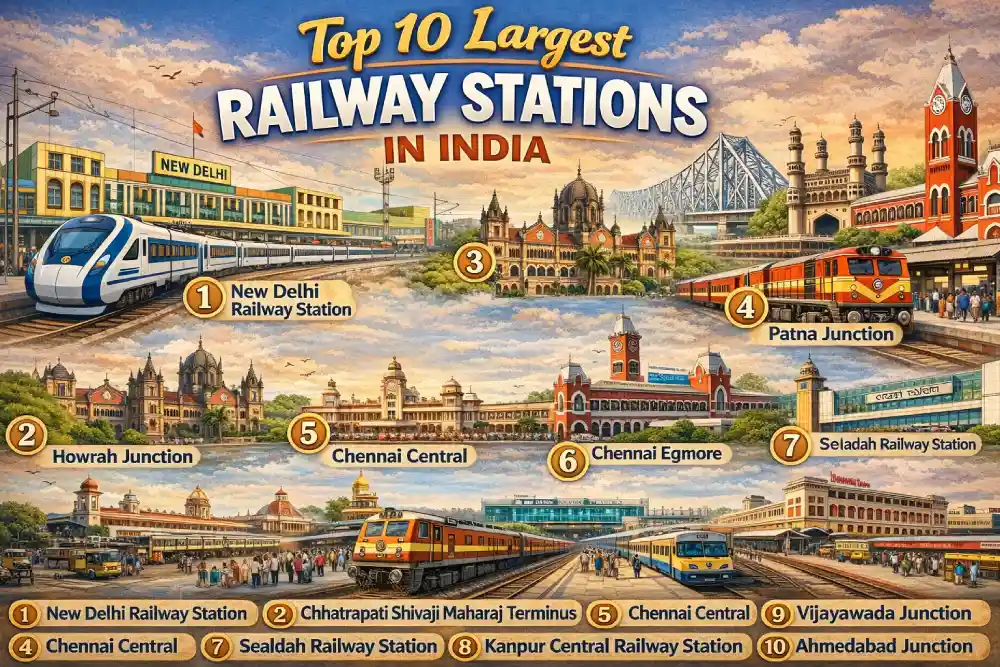
1. New Delhi Railway Station (NDLS)
Just step into Paharganj and you will see the welcome instantly. Autos circling in loops, drivers shouting, people dragging luggage — some running, some stopping suddenly. Someone is always calling a taxi.
Inside, the station feels massive. Bigger than you expect. You think of one platform, then you see sixteen — and realize more trains arrive than you could possibly count. Rajdhanis, Shatabdis, express trains, local trains — Delhi connects to almost everywhere.
Regular travellers move differently here. They walk like they know invisible shortcuts. They know where the tea stall is, where it’s quieter, and which corner will soon become crowded. Old book stalls, snack vendors, chai counters — many have been here for decades.
Sitting on a bench with a hot chai and watching the controlled chaos is part of the NDLS experience. Many travellers now prefer ordering meals directly to their seat using train food delivery apps, which has quietly changed the journey routine.
2. Howrah Junction (HWH)
Howrah Junction feels historic the moment you approach it. Red brick walls, the massive building, and the nearby bridge with river breeze — the past and present blend immediately.
Trains keep arriving and departing in a steady rhythm. Local trains, long-distance expresses — constant movement without pause. Some passengers arrive early just to eat. The food stalls here have loyal followers.
Fish cutlets, kachoris, Bengali sweets — someone is always eating while walking. The crowd expands and contracts almost like breathing. One moment the platform feels packed, the next it briefly clears before filling again.
Old walls, new trains, constant energy — Howrah never truly sleeps.
3. Mumbai CSMT
Chhatrapati Shivaji Maharaj Terminus is instantly recognisable. Even first-time visitors feel they’ve seen it before — perhaps in films or photographs.
Local commuters rush with precision. Long-distance travellers weave through the flow. Vendors balance trays while announcements echo under the high heritage ceilings.
Someone eats vada pav while walking. Someone pauses to photograph the Gothic architecture. People stare at electronic boards, checking train numbers again and again.
It’s loud but strangely organised. You either feel absorbed into the machine — or stand aside watching Mumbai move at full speed. The blend of heritage and hustle leaves a strong impression.
4. Patna Junction (PNBE)
Patna Junction carries a strong emotional pulse. Migrant workers returning home, families waiting anxiously, passengers rushing for connections — everything feels personal.
Food aromas travel far here — litti, samosas, sometimes fresh jalebis. Chai sellers weave through the crowd calling out rhythmically.
When a major train arrives, the platform suddenly empties and then fills again within minutes. People carry bags, trolleys, sweet boxes — and sometimes just stand watching the movement.
It’s busy, but not mechanical. The station feels human, warm, and deeply alive.
5. Chennai Central (MAS)
Chennai Central is easy to identify from a distance — the iconic red-and-white building stands out immediately.
Inside, movement is constant but more structured. Announcements are clear. Signboards help passengers navigate without too much confusion.
Travellers heading across South India move with purpose. Food counters serve idlis, dosas, and strong filter coffee. Many passengers grab something quickly before boarding.
Some sit on the floor with plates beside stacked luggage. Footsteps, whistles, and announcements blend into a steady background sound. The station rarely feels empty — only slightly quieter at times.
6. Chennai Egmore (MS)
Chennai Egmore feels calmer compared to Central. The building is older, the pace slightly slower — at least on normal days.
But during festivals and holidays, the calm disappears quickly. Families with luggage, children running, people arguing over seats — the familiar Indian station chaos returns.
Yellow walls, high arches, and broad corridors give Egmore a distinctive character. If you pause, you notice small details: a wobbling fan, sunlight patterns on the floor, the echo of an arriving train.
It may be less flashy than Central, but it remains deeply important, especially for travellers heading to temple towns.
7. Sealdah (SDAH)
Sealdah railway station is part of daily life for Kolkata commuters. Local trains keep arriving relentlessly.
Platforms fill with students, office workers, and long-distance passengers. Outside, narrow lanes and street food stalls create constant buzz.
The crowd has its own rhythm. Sometimes you spot small arguments, sometimes reunions. Someone drops a bag. Someone laughs loudly.
Sealdah is a lifeline for millions — even if many tourists overlook its importance.
8. Kanpur Central (CNB)
Kanpur Central railway station hosts a complete cross-section of travellers — workers, students, traders, families.
The station rarely feels empty. Foot overbridges stay busy almost all day. Waiting halls remain crowded.
Morning brings the smell of fresh jalebis and kachoris. Midday brings heavy movement. Evening briefly slows before the next rush begins.
A child runs past. Someone asks for directions. Vendors keep moving through compartments. The memories formed here often stay long after the journey ends.
9. Vijayawada Junction (BZA)
Vijayawada Junction is one of India’s key railway crossroads. Multiple routes intersect, so trains arrive one after another.
Passengers buy snacks, idlis, and full Andhra meals. Some eat while walking, others settle on benches.
The platforms appear relatively clean, but footprints and constant motion remind you how busy it really is. Announcements trigger immediate crowd movement.
Tourists sometimes stop for photos, while locals move with routine familiarity. The station feels busy yet strangely balanced.
10. Ahmedabad Junction (ADI)
Ahmedabad Junction appears bright and relatively organised. It connects multiple major routes across western India.
Food stalls remain busy with dhokla, fafda, and kachori. Luggage carts move continuously.
The station feels full but not overwhelmingly crowded. Some passengers rush, others wait patiently, and some simply observe the flow.
Even small details — a creaking fan or slightly delayed announcement — become part of the station’s everyday rhythm.
Conclusion
Every major railway station in India has its own personality. Some overwhelm you immediately, some feel familiar and comforting. What stays with travellers are often the small moments — the smell of chai, a vendor’s call, the rush of footsteps, a child pulling a parent forward.
Train journeys in India are never just about distance. The stations themselves become part of the memory — alive, human, and always in motion.
Read Also :- How to Travel from India to Nepal-Full Guide